Capstone Details


Project Information
- Ultrasonic Transducer Array Characterization
- Project date : Spring 2026
- Progress Bar : Project Completed
100%
Project Overview
This capstone project focused on the electrical and resonance characterization of a 40 kHz ultrasonic transducer ring designed for future ultrasonic-guided plasma experiements. The system was developed to investigate how high-frequency acoustic fields may influence heated air regions and support controlled plasma discharge behavior.
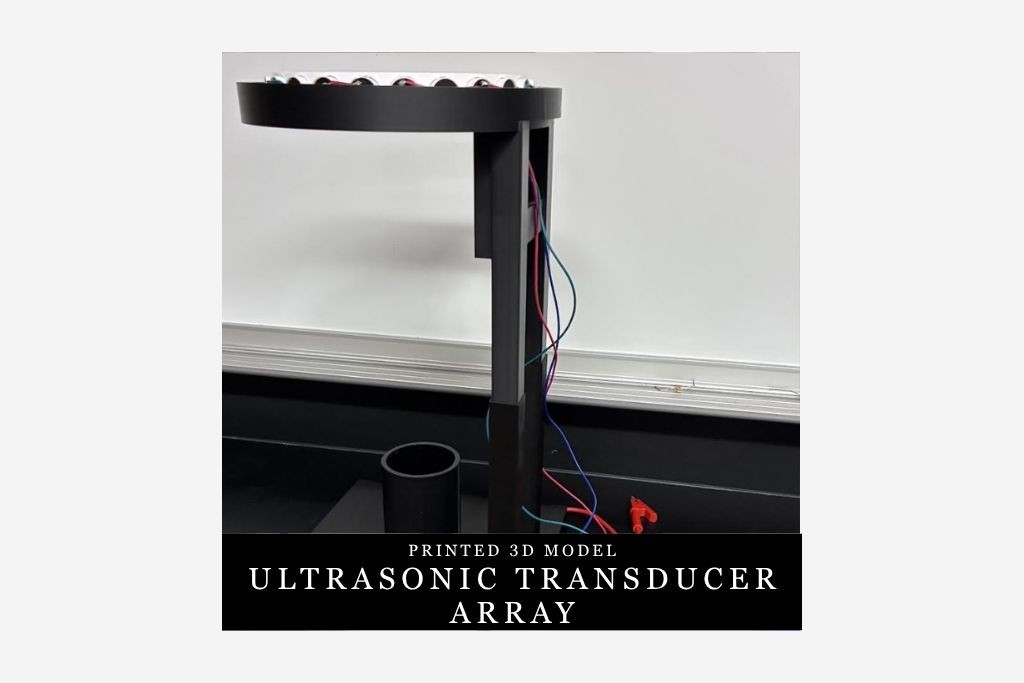
A 23-element inward-facing ultrasonic transducer array was designed, assembled, and experimentally evaluated using custom driver circuitry, oscilloscope measurements, and frequency sweep analysis. The transducers were integrated into a custom-fit 3D printed mounting structure designed to surround the future plasma discharge region and provide repeatable positioning of the acoustic field.
Electrical response was characterized through RMS current measurements to identify resonant operating conditions and determine the frequency region where electromechanical energy conversion was strongest. Experimental testing identified a resonant operating region near 42.5 kHz and established practical operating conditions for future plasma guidance studies.
Key Features
Custom 3D Printed Mount for 23-Element Ultrasonic Array
Designed and fabricated a custom-fit mounting structure to position and support the 23-element ultrasonic ring around the intended plasma discharge region.
Custom Driver Electronics
Built and operated a MOSFET-based drive system using a TC4427 driver, function generator, and 12 V power supply.
Resonance Characterization
Perfomed frequency sweeps and RMS current measurements to identify resonant operating behavior near 42.5 kHz.
Future Plasma Guidance Applications
Established operating conditions to support future experiments involving acoustic manipulation of heated air and plasma discharges.